
Too many chefs: What unclear website ownership actually costs
What is the true cost of unclear website ownership? We spoke to professionals in the field to see how teams are solving website ownership issue today.


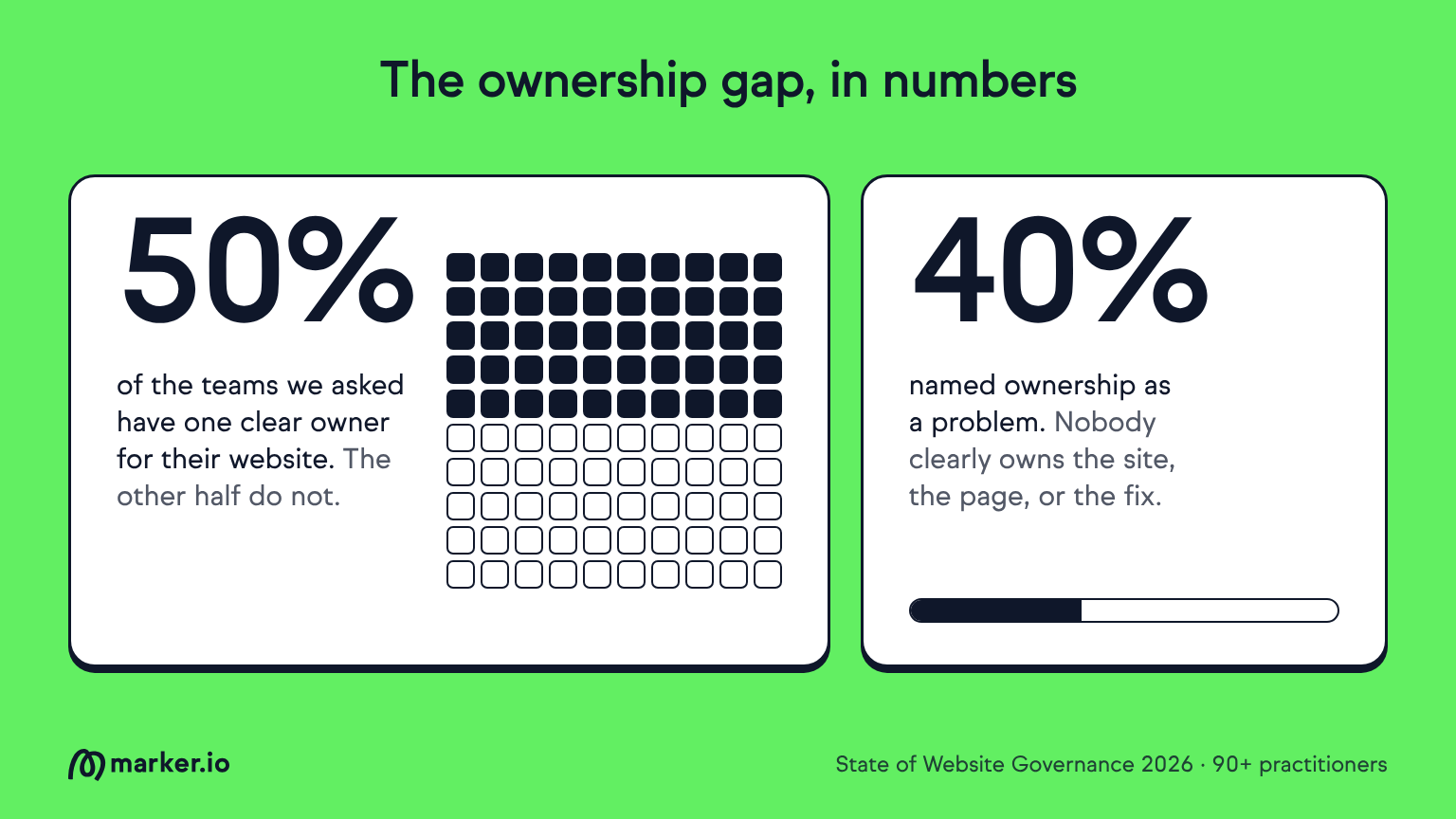
On a Tuesday morning, a potential client fills in the contact form on a law firm's website. She clicks submit, sees the thank-you message, and waits for a call. It never comes. By Friday she has hired someone else.
Nobody at the firm knows she existed. The form still loads, the thank-you page still appears, and the site looks perfectly healthy. But somewhere along the way the notification email stopped being delivered. It takes three weeks, and a partner asking why enquiries have dried up, for anyone to look.
When they do, the questions start. Wasn't the agency watching that? The agency handed the site over after launch. Wasn't IT? IT looks after the network, not the website. The hosting company? They keep the server running, and the server was running fine.
Garrett Goldman, whose company StateWP takes over WordPress sites for professional-service firms, sees versions of this all the time: forms that slowly stopped sending, certificates that expired because nobody paid the renewal. None of it is a technology failure. Every one of them is a missing owner.
“Most organizations do not have a website problem. They have an accountability problem.” — Garrett Goldman, StateWP
We asked practitioners how they govern their websites today. Almost every answer came back to that same word. Here's what ownership problems look like from the inside, and how the teams living with them are fixing it.
Three teams, one website
When we asked Miguel González to describe his website governance process, he didn't reach for a framework. “It's a bit of a mess I am afraid,” he wrote.
Miguel runs the website at Spain Sotheby's International Realty, where the site is the second-biggest source of leads. It isn't a side project. It's a sales channel.
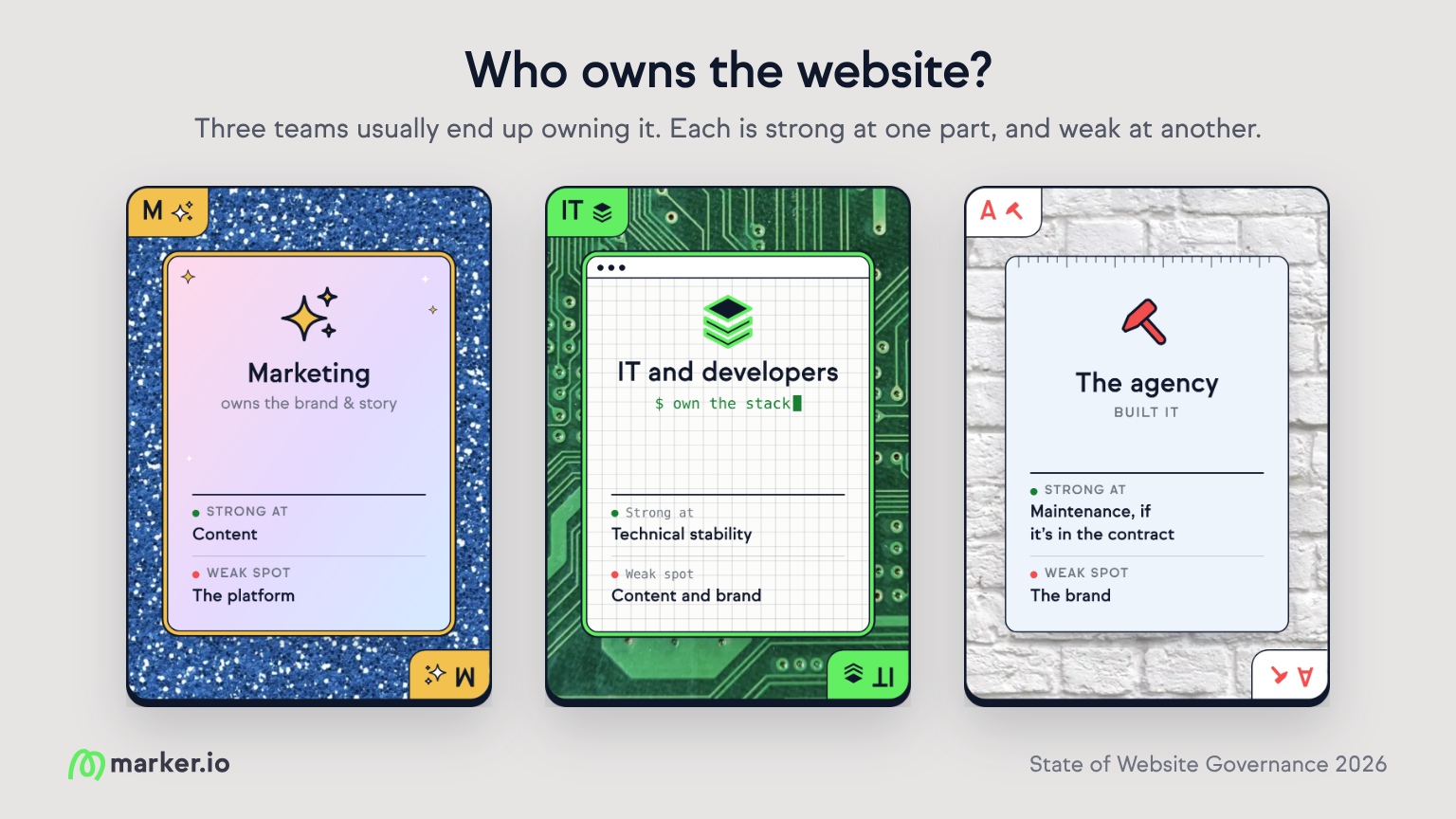
Three departments work on it. IT handles development and analytics. Brand handles web and graphic design. Performance, Miguel's team, handles SEO and paid search. Miguel acts as the coordinator in the middle, trying to make the site useful for the people who depend on it most: sales.
On paper that's a sensible split. In practice, Miguel describes something more human. Every team wants credit when the site performs. Fewer want to propose the risky improvements that might make it perform better. And nobody wants to be blamed when something goes wrong.
If you've worked on a company website, you've probably been in that meeting.
Everybody's responsibility, nobody's decision
Miguel's situation isn't unusual. It's what most company websites become once more than one team touches them. Marketing owns the messaging. Product owns what the features actually do. Legal owns the claims. IT owns the infrastructure. Each responsibility is clear on its own. The trouble is that a single page touches all of them, and nobody owns the page.
“The most common breakdown I see is that the website becomes everybody's responsibility and nobody's decision system.” — Jennifer Neeley, JND Global
Jennifer, a fractional CMO, describes how this plays out over time. Every team does its part, and leadership assumes someone is reconciling the whole thing. Nobody is. Pages start contradicting each other, outdated claims linger, and the company presents a slightly different version of itself depending on where a visitor lands.
The gaps show most clearly at the handoffs, where each team assumes the other is the safety net:
“Content assumes development will catch the technical issue, while development assumes marketing approved the message.” — Graham Mann, SEOTakeoff
Go back to the law firm's broken form. The agency assumed the firm was watching it. The firm assumed the agency was. Both were reasonable assumptions, and both were wrong.
From inefficiency to damage
Most of the time, unclear ownership just makes things slow. Miguel describes the typical case. Every so often the connection between the website's CMS and the company's CRM breaks, which means leads from the site may not reach the people who follow them up. Someone usually notices. That isn't the problem.
“[They] normally don't really know who to notify and it ends up in a big email thread, so it takes us more time to find a solution.” — Miguel González, Spain Sotheby's International Realty
The issue gets spotted. It just doesn't get routed. And every hour spent in that email thread is an hour the break stays live, on the channel that brings in the company's leads.
Sometimes, though, the cost stops being time.
Rafay Baloch is a security researcher who has spent his career finding vulnerabilities in web applications. He has seen what happens to the parts of a website nobody remembers owning. In one case he dealt with, a company had an old subdomain still running, forgotten during a period of fast growth, on software that hadn't been updated. Within weeks it was under attack. The company lost its customers' confidence and had to work to repair the damage to its brand.
“If everyone owns a page, no one updates it.” — Rafay Baloch, REDSECLABS
Nobody decided to leave that subdomain exposed. It simply belonged to no one, and that turned out to be the same thing.
What fixing it looks like
When a firm brings its website to Garrett's team, the site often arrives in the state described at the start of this article. Plugins nobody remembers installing. Tracking scripts marketing added without telling anyone. A form that stopped sending months ago. Three outside parties who each believe the gaps belong to someone else.
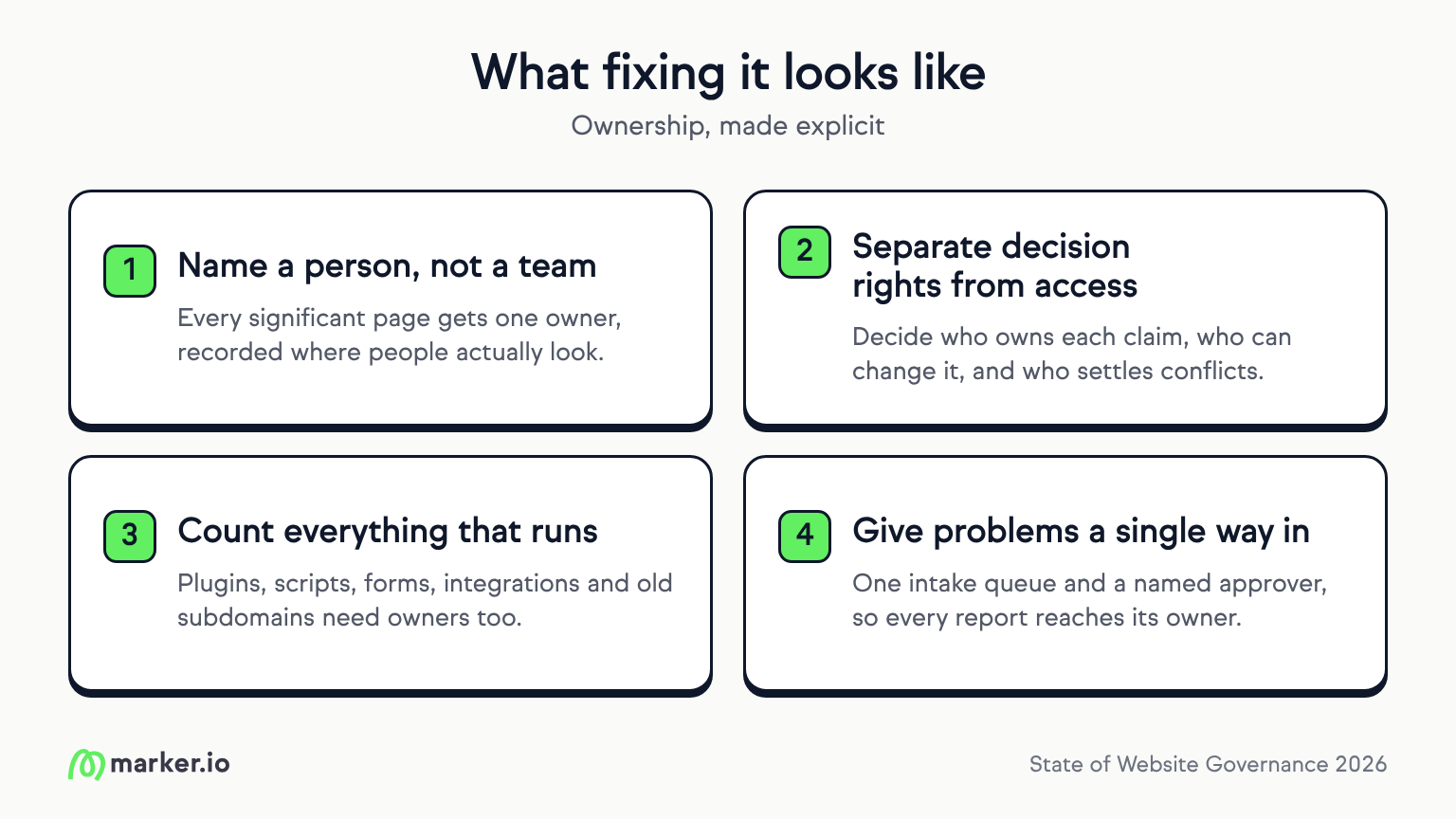
The fix, as Garrett tells it, is almost boringly simple. First, one named owner per site, written down. Not “the agency” or “IT”, but a person. Then a full inventory of everything actually running on the site, including the things nobody mentioned. Then reviews on a fixed calendar, instead of whenever someone happens to notice a problem. And finally, a written boundary that says what each party covers and, just as importantly, what they don't, with someone made responsible for the space in between.
None of that is new technology. It's ownership, made explicit. The other practitioners we spoke to describe the same moves from different angles:
Name a person, not a team. Every significant page gets an owner, recorded somewhere people actually look. When someone changes roles, the record changes too.
Separate decision rights from access. Jennifer suggests deciding who owns each claim, who can change it, what evidence supports it, when it must be reviewed, and who settles conflicts between brand, legal and subject-matter experts. That turns “who's responsible?” from a debate into a lookup.
Count everything that runs, not just pages. Plugins, scripts, forms, integrations and old subdomains need owners too. Rafay's advice is to list every asset, assign each one, and control who can access it.
Give problems a single way in. Graham runs every change through one intake queue with a named approver, plus an extra reviewer for risky work like templates, redirects and legal copy. The same idea solves Miguel's email thread: whoever spots a problem should know exactly where to report it, and the report should reach the owner without anyone having to work out who that is.
Back to Tuesday morning
Picture the law firm's contact form again, this time with an owner. A named person who knows the form is theirs. A check that tests it end to end, not just whether the page loads. An alert that goes straight to that person the day the notification stops arriving, not three weeks later when a partner asks where the enquiries went.
The client who submitted it on Tuesday gets her call on Tuesday afternoon.
Or picture Miguel's next CMS-to-CRM break. Instead of a colleague wondering who to email, the problem lands with the person responsible for that connection, with the page and the error attached. No thread. No detective work. Just a fix.
Neither scenario needs a reorganization. It needs every part of the website to belong to someone, and every problem to find its way to them.
Where Marker fits
In most of these stories, someone saw the problem well before it got fixed. Marker.io lets your team, clients or testers report issues straight from the live page. Each report includes a screenshot, the URL, browser details and console logs, and lands in the tool your developers already use, like Jira, Trello, Asana or Linear. No email threads, no treasure hunts.
Marker.io now also scans your whole website on a schedule with the new website monitoring feature. Get each issue with a screenshot and a suggested fix, sorted by severity and assigned to the right person in your team's backlog.
What should I do now?
Here are three ways you can continue your journey towards delivering bug-free websites:
Check out Marker.io and its features in action.
Read Next-Gen QA: How Companies Can Save Up To $125,000 A Year by adopting better bug reporting and resolution practices (no e-mail required).
Follow us on LinkedIn, YouTube, and X (Twitter) for bite-sized insights on all things QA testing, software development, bug resolution, and more.
Related blog posts

Get started now
Free 15-day trial • No credit card required • Cancel anytime